
Beyond chatbots: what AI can actually do for your business
A chatbot waits for you to prompt it. But the real value of AI is in the form of agents that do whole jobs in the background. Here are eight real examples, and none of them is a chatbot.
Ask a business owner what AI could do for them, and most describe a version of the same thing: a smarter search box, or a chatbot on the website that answers customer questions. That's the picture the last two years have painted — you type a question, it types back.
It's a useful picture. It's also the smallest version of what's actually on the table.
A chatbot waits for you to prompt it. The more valuable kind of AI doesn't wait — it does whole jobs in the background, on a schedule, without anyone sitting at a keyboard. That shift — from a tool you operate to an agent that does the work — is the part most owners haven't seen yet.
So instead of explaining it, let me show you. Everything below is a real, working system — the ones I run my own businesses on, and ones we've built and shipped for clients. None of them is a chatbot.
In your day-to-day operations
Bookkeeping that does itself. I run a short-term-rental business, and like every business it generates a steady drip of receipts and statements — cleaning, supplies, utilities, vendor invoices. The old way is a folder that fills up all month and a dreaded Sunday of data entry. The new way: each receipt is read automatically, matched to the right account, and posted to the profit-and-loss as it arrives. The books stay current to the day, and the hours of monthly entry are simply gone.
Pricing that moves with demand. Most small operators set a price and leave it there — which means leaving money on the table on the busy dates and sitting empty on the slow ones. Instead, a demand model scores every upcoming date — local events, holidays, seasonality, day of week — and recommends a nightly rate. Prices move with the market on their own, so the calendar fills at the right number instead of a flat guess.
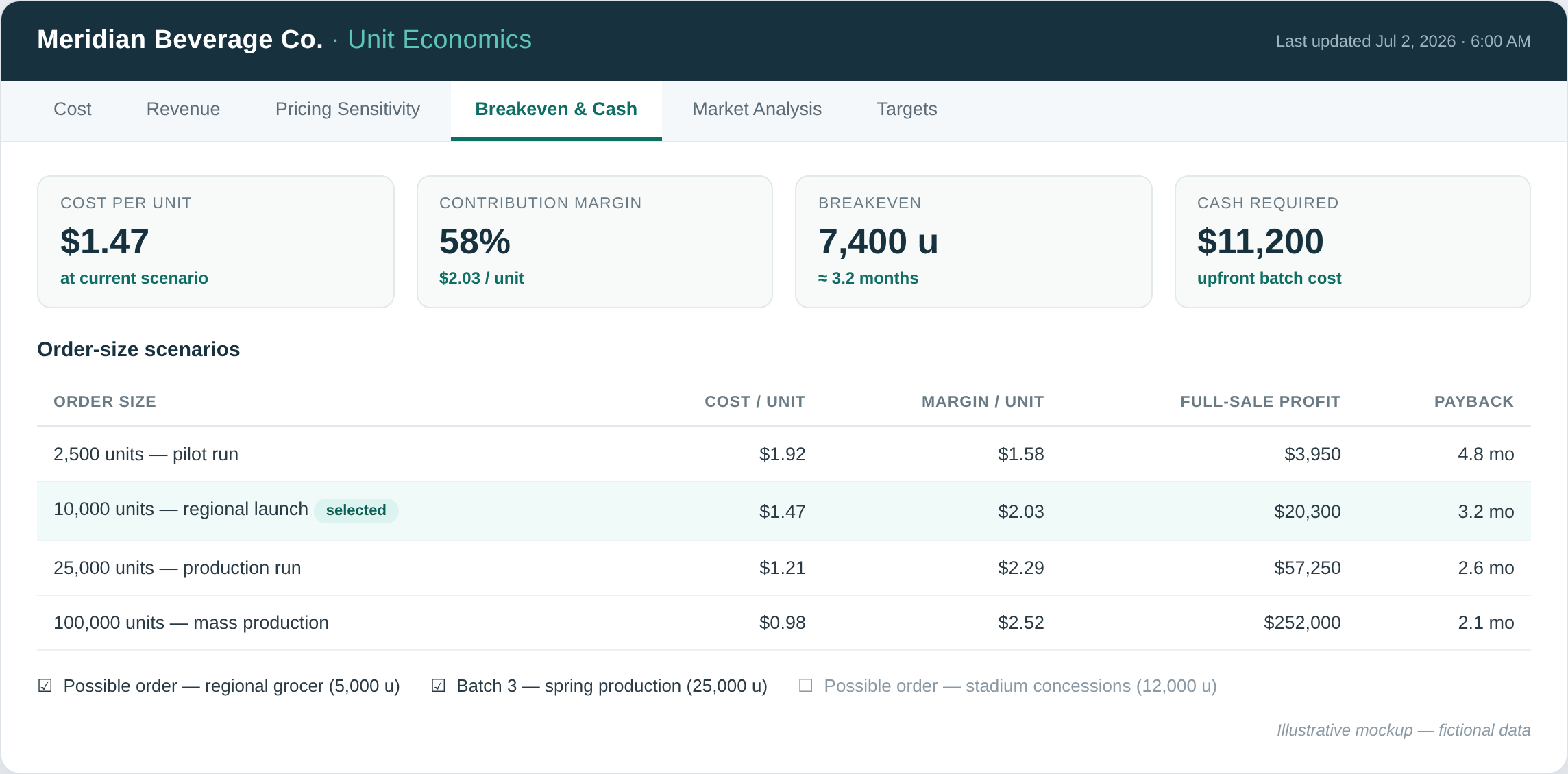
Knowing your numbers before you commit. A specialty beverage company we work with needed to know its real unit economics — what each unit costs and what margin it earns — across very different order sizes and sales channels, from a pilot run to mass production. That used to be a fragile spreadsheet nobody trusted. Now a model computes cost, margin, breakeven, and the cash required at every order size and pricing scenario — and the founder can check a possible order or production batch on and off and watch the whole picture recalculate. Test the price, see the payback, then sign the production order. Not the other way around.
In understanding your market
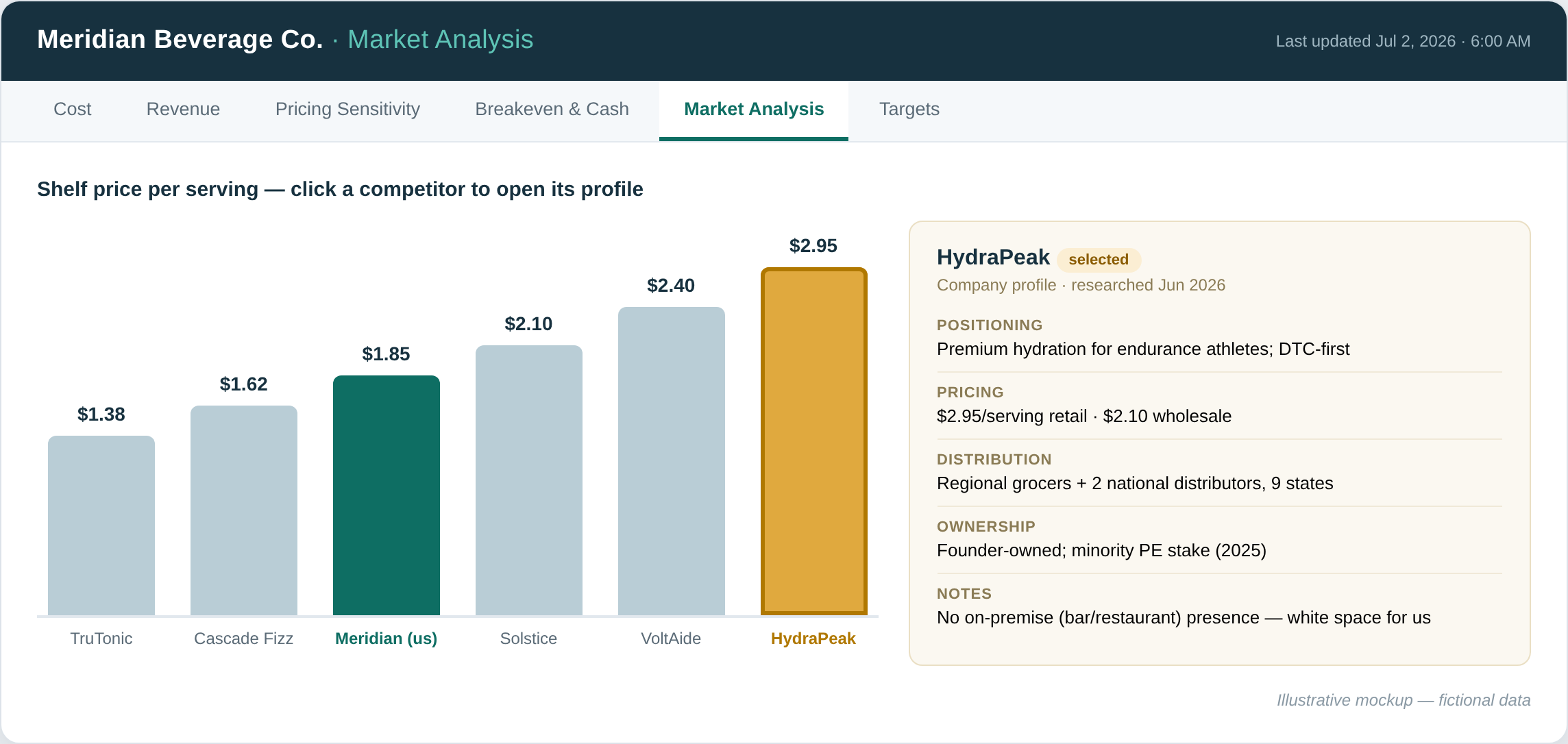
Knowing exactly where you're priced. In the rental business, there are roughly twenty comparable listings nearby, and their prices move constantly. Nobody has time to open twenty browser tabs every week. So an agent checks every comparable automatically and ranks our price against theirs for each open date — telling us precisely where we're priced high, where we're priced low, and where there's room to move. The competitive picture refreshes on its own. We've built the same kind of pricing map for a physical product too — where a bottle lands per serving against every competitor on the shelf. And on that map, clicking any competitor opens a researched profile: how they're positioned, what they charge, who distributes them, who owns them. The kind of market study that used to be a consulting deliverable, sitting in a tab — because the question is identical everywhere: am I priced right, right now?
Reading what your customers actually tell you. Reviews and messages pile up faster than anyone reads them closely, so most owners run on a gut feel about why people buy. Instead, every guest review and booking message gets mined into themes — what people consistently praise, what they quietly criticize, how we stack up against competitors, and why repeat guests come back. It turns a pile of text you'd never finish reading into a short list of things to fix and things to lean into.
In growing the business
Finding the right prospects before you ever call. For a Commercial Real Estate Services Firm, business development too often means calling whoever someone happens to remember. We built them a system that scans the market for companies matching their ideal client profile, scores each one on real signals — size, growth, the kind of space decision that's likely coming — and hands the team a ranked target list. Pick any name and it opens a full workup: the company profile, its real estate footprint, a timeline of buying signals, and a pursuit plan.
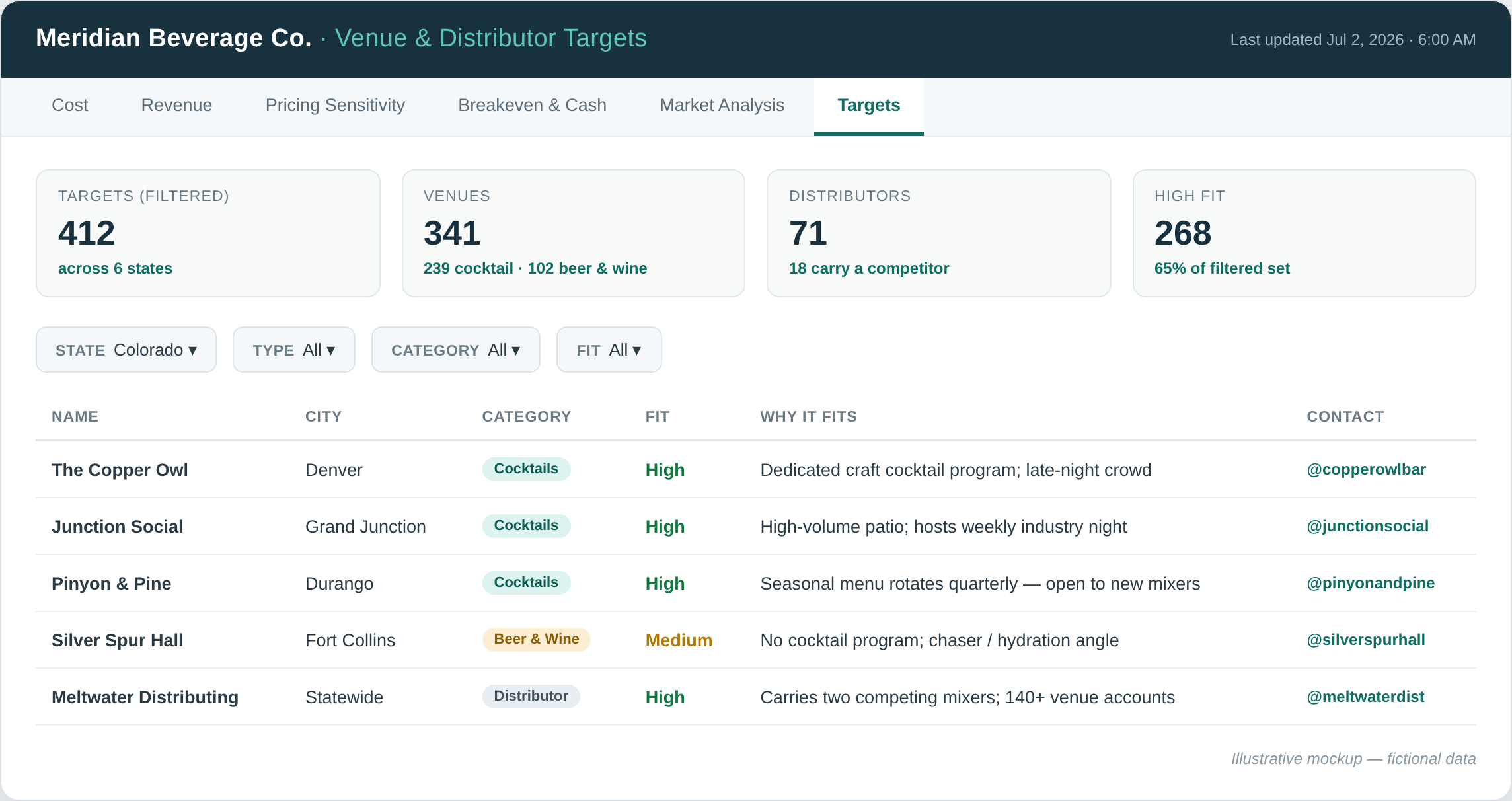
The same engine works for a physical product. For the beverage company, the question wasn't which companies — it was which bars, restaurants, and distributors, in which towns. So agents swept six states and built a map of hundreds of venues and the distributors who serve them: each one categorized by type, scored for fit against the brand, noted with which competing products its distributor already carries, and paired with a contact. The founder picks a state and a venue type, and the shortlist is sitting there — with the reason each name made the list. The list-building that used to eat weeks now arrives done.
Proposals that draft themselves. Once a team picks a target, the next time-sink is the custom pitch — a day of someone's work, every time. So an agent researches the prospect, then drafts a tailored, on-brand proposal — the narrative, the deck, the positioning — ready for the team to refine and put their name on. The blank page is gone; what's left is the judgment only they can add.
Marketing that runs on a schedule. A financial planning and investment management company we're working with faces the same problem every advisor does: the right people to reach are scattered, and the moment to reach them is easy to miss. So we built them a command center that watches for the signals that actually matter — a business owner heading toward a sale, a liquidity event, a life change — and flags who to contact and when. Paired with it is a campaign engine that drafts the outreach and the content on-brand, sequenced and ready for review. Nobody's staring at a blank calendar wondering who to call; the system surfaces the who, the why, and the first draft.
The thread that ties these together
Look back at those eight, and notice what they have in common.
Not one of them waits for a prompt. Each is a job — bookkeeping, pricing, cost modeling, competitive research, customer analysis, prospecting, proposal-writing, marketing — that used to need a person and now mostly runs itself. Each was set up once, in a matter of hours, and now runs on a schedule in the background. And none of them asked the owner to learn a new tool, master prompting, or hire a developer. The work just gets done, and you read the results.
That's the difference between a chatbot and an agent. A chatbot makes you a little faster at a task. An agent takes the task off your plate.
The point isn't that you should rush out and build all eight. It's that the question worth asking has changed. It's no longer "how do I use ChatGPT?" — it's "which jobs in my business could just… run?" Almost every business has a few, and they're rarely the ones you'd guess.
Where to start
Figuring out which jobs those are — for your business specifically — is exactly what our Art of the Possible Workshop is for. We sit down with how your business actually works and map the handful of jobs AI could take over first, ranked by what they'd give you back in hours and margin. No homework, no jargon, no tooling to learn — just a clear, practical picture of what's possible.
If you've been picturing a chatbot, it's worth seeing the rest.